Saturday, February 18, 2017

Wild bowels, wilder ideas


Probably known for others but an unpleasant surprise for me: I am full of s**t!
Four days and counting with a brutal diarrhea has been an unwanted lesson on body (dys)functions.

Enough of the downstream.

I have had a lot of time to think in the bathroom.


Like travel industry.
Dhaka can boast with a number recently opened luxurious hotels, and new projects are under construction both in the capital and other cities.

Why?


Bangladesh can already now offer everything that the rich, experienced, fit, adventurous traveler is looking for.

Surprisingly many people are willing to pay huge sums for hunger, sweat, pain and struggle - all renewable natural resources in Bangladesh.


Who has not done the mountains, the seas, the skies, the Moon, the five big?
An irresistible idea for the real adventurer: work as a laborer in Dhaka.
The concept is simple: the traveler collects an outfit (lungi, t-shirt, head scarf, flipflops, optional underwear for men, all-body-covering and far too warm clothing for women) and works like a slave at least ten hours a day all week.
He earns one hundred taka (1,2 US dollars) a day, sleeps in a metal/straw hut with tens of other men, does his business in a open sewage. She can get employment in the garment industry, housing in the slums, earning a little less.

Daredevils can clean high-rise windows, real machos may collect garbage or pull a rickshaw.


And since the concept is sustainable, fair, ecological and all-good, the man or woman replaced by the traveler, gets paid at least 500 taka a day - with an obligation to attend school classes or occupational education.


After a week: a nice tan (men), remarkable weight loss, bigger muscles, new understanding, much to tell back home. Ok, maybe  sunstroke, diarrhea, fatigue - part of the game.


Can be combined with a couple of days at a luxury hotel, relaxing, feeling good and drinking a beer that costs more than the whole week's earnings.

Friday, February 10, 2017

No purchase but many smiles


New Market is a  famous Dhaka institution. And as the name implies, in banglalogic , it is one one of the oldest markets in Dhaka. 


New Market was founded when people got tired of the busy (read seriously overcrowded) streets of Old  Dhaka. New Market would be the showpiece of Dhaka's modernization in the 1950s. 


New Market is said to be triangular in shape with a triangular lawn with a mosque in the center. 


Well, we found the mosque (under reconstruction) but I am not sure about the lawn. Whatever, it was an exciting experience. 


We went there early on a Friday morning when most of the stores were just opening. For Dhaka people, it was empty - for people from scarcely populated countries it was jammed.


Our driver said that we should return in the evening when it was really busy and we could experience the real nature of the market place. Honestly, the unreal nature was enough.


The pictures hopefully give a little idea of the atmosphere though the most impressive experience was all the smells. 


Fish, meat, sweat, urine, dirt, spices, city, sleep, dust. Not exactly something you would spray behind your ear. 


And I am afraid that the smells are much stronger in the summer when the temperature in about the double. Now it's winter time with 25 to 30 Celcius (77 to 86 Fahrenheit).


New Market is a place where you can buy anything essential for the local life - from fish to meat, household objects, sandals and clothes.


You can negotiate the price but the smile is always free.

Saturday, January 14, 2017

Up in the air


 The capital of a nation is often very different from the rest of the country. 
In Dhaka's case this is very true. Dhaka is a hyperactive, polluted and noisy megacity. Most Dhaka people travel back "to the village" whenever they have the chance.


I was fortunate (yes, once again) to join a helicopter tour from Dhaka to Chittagong and clearly see the difference between the 20 million inhabitants' capital and "the village". 
From the air the capital looks like an unorganized nest of buildings after buildings after buildings, the countryside a vast plain. 


At two hundred meters we were low enough to see all the wonderful colors, small villages, cows, river boats and bridges but high enough not to see the rural misery, hear the noises and feel the smells.

There were many rivers, man made ponds, natural lakes, shrimp and fish farms. Finally, the sea side with long beaches, closer to Chittagong also the ship wrecking yards.


The largest part of the tour was, however, an unending chess board of green, yellow, brown, grey and black fields. Wet fields, dry fields, blooming and barren fields. 
Food, in other words.

Bangladeshis think of food a lot, eating is a national sport. 
For the tens of millions poor Bangladeshis earning a meal is a daily struggle while rich people fight against obesity.
Rich or poor, people are unbelievably hospitable. 


A dinner invitation by an affluent host can be a challenge. As a newcomer I made several times the mistake of believing that the starters were the main dish. After many rounds of salads, pies, vegetables, small and big other dishes, the table was suddenly loaded with the main courses: fish, mutton, beef, chicken, vegetables and rice. More is not enough is the principle.


Rice is inevitable. There is no meal without rice. You can eat a whole pizza and then go to dinner. Why? Because there was no rice with the pizza.
After a while, I have learnt to eat slowly. If your plate shows the smallest signs of an empty spot, it will be heaped up with all and everything.
When you feel that you are about to explode, it's time for the dessert: sweet cakes, sweet ice cream, sweeter than sweet yoghurt. 

The pictures are hazy, it was slightly foggy, and there is a lot of pollution in Dhaka. Plus I am an amateur photographer.


Friday, January 6, 2017

Devastating start to 2017


 Last year in Bangladesh was rather challenging. This year didn't start very well either.
On Tuesday a furious fire destroyed a large Dhaka market with more than 300 stores. While the flames were swallowing the market and the future of thousands of people, an earthquake frightened the rest of the country.


"I lost my store and my income, so did my brother who also had a store here", told a shopkeeper when I visited the ruins of Gulshan 1 DNCC market on Friday.
Smoke still rose from the rests of his store, it was burning hot. And certainly not safe, the building could collapse any time.
Half burnt lingerie at his store was covered with black ash and rubble. It looked sad and it felt hopeless.


All over the ruins one could see burnt shoes in heaps, blackened shampoo bottles, mountains of ashy rubbish. The floors were covered with dark grey water, the building stank of dirty smoke.

The shopkeeper was, however, confident that he would be granted a space in a shopping center that will be built on the ruins of the burnt market.
There have been many rumors that the fire was not accidental but a well planned plot to get rid of the relatively rundown market quickly and effectively.


The 5.5 magnitude earthquake, some 160 kilometers east of Dhaka, had tragicomic consequences for our household.
That day my husband attended a meeting where he had been sitting in the same position for a long time. His legs were asleep when the tremors started. Everyone had to leave the building, and my husband wrenched his ankle while stumbling out. His foot first swelled like a dough, now it's blue.
So, I have "an earthquake casualty" in the house.

Let's hope that the year will have some good surprises, too. Happier 2017 everyone.


Saturday, December 17, 2016

A nation in red and green


Bangladesh was dressed in red and green this week. The country celebrated its 45th Victory Day on Friday. 
The streets were crowded with people in red and green clothes, scarves and hats - the colors of the young nation. Cars, rickshaws, bikes, shops and office buildings were decorated with national flags in all sizes and shapes.


Bangladesh had a very bloody birth, followed by much violence and suffering. There has been a lot of progress but for a newcomer the country still looks like - I apologize - a mess. But the society seems to be functional, in a Bangla way.


I was lucky to be invited as a spouse to the President's Victory Day reception on Friday afternoon. Thousands of people were listening to patriotic music and mingling in the presidential garden, physically very close to thousands of poor people just outside the palace.


My husband attended the formal celebrations relay which started at dawn by wreath laying and continued by a military parade. 


I followed the parade on tv - it was a show-off of national pride and military muscles mixed with political propaganda.
Every single piece of the armed forces from fighter planes to attack elephants and army excavators were exhibited.
It is very dusty during the winter in Bangladesh but in the parade everything looked brand new and shiny. 
Photo credit for the parade pictures goes to my husband, the rest are my mobile phone shots.

On the personal note I feel very blessed just now. Both of my "babies" are visiting us in Dhaka. The whole family can be together for a couple of days. 

Happy holidays!

Saturday, November 19, 2016

Super gloom


Lesserwisser has been hibernating a while. Actually I would like to wake up round 2020 and hope that the world still exists, people are wise and live in peace and harmony.
Unfortunately, the future looks more like I observed the super moon over Dhaka. Not very bright, not very big, rather super gloom. (Sunset in the picture above).


Terror, killings and violence are just escalating in Bangladesh. Recently the target have been Hindus and Santals. 
Hindu homes and temples in the eastern part of Bangladesh were under fierce attacks after a local youth allegedly shared a Facebook posting that Islamic hardliners said denigrated a holy site for Muslims.
Muslim hardliners protested and demanded action against the Hindu youth, who is illiterate and probably didn't write the posting.
Later at least four members of the indigenous Santal community were killed and more than thousand Santal families were forced to abandon their homes in the northern part of Bangladesh due to a land dispute. Santals belong to one of largest indigenous tribes in the area.
Radical islamism is tightening its grip of Bangladesh. This is also clearly visible in the streets of Dhaka where more and more women go more and more covered.


The pictures are taken from our building's roof top - the only place we can be outside in addition to expat clubs.
Life in Dhaka for foreigners gets more and more limited day by day. The streets are full of armed police men, check-points and security people. One is not supposed to walk at all. At the same time the traffic is, if possible, worse than ever. 

We are lucky to have the rooftop. With a pool, or rather an overgrown tub.
But I will never swim there after I saw a maid washing clothes in the pool. She had hung the washed items in the trees.

But not all is bad - I will start at a new part time job this week. At the moment the temperature is very pleasant, the air is not as polluted as in the winter and the mosquitoes haven't arrived yet.


Thursday, September 29, 2016

Bangladeshi Star Wars


Terror attacks, earthquakes, demonstrations, suffocating traffic, extreme poverty, incredible wealth, misery, happiness, corruption, hope, despair.
Plus many other things.
Over 400 days down - who counts - some 300 to go - who counts.


Suddenly I am a senior in Dhaka. Now I have a faint idea of directions, places and people. I can tell where to get a haircut, what to wear, who to tip, what to eat and what not.
Still, every day in Dhaka is a big surprise - inspiring but also exhausting.


During the first year here I have become an expert in protecting myself. Due to the circumstances.
The day starts with brushing my teeth with filtered water to avoid diarrhea. This is worth mentioning since exactly today I have spent most of the day close to the bathroom.
The Dhaka water quality not only eats one´s inner organs but also hair. I have lost half  of my hair and will probably be totally bald when we move from Bangladesh.
Next: one lotion to protect the skin against the sun, another against mosquitoes.
All-body-covering clothes against stares and giggling. This never works, my wrinkled facial skin is a major attraction anyway.


At home we have two metal coffins full of equipment in case of an earthquake. Plus a satellite phone.
Seven locks, iron bars, armed guards before entering a car with tinted glasses for transport. 
Metal detectors at the entrance of the grocery store. Bullet proof windows. Armored cars. No-stay at the rooftop terrace because of potential snipers.
The list gets longer and longer, more and more advanced daily.
The security measures in Dhaka have become a kind of star wars between  embassies, organizations and companies. The bigger the guns, the safer the lives of the employees.

Maybe.
The security measures rule out the bad but also the good.
This is what the terrorists want: deprive people of their normal life, suffocate them with security and isolation, finish with insanity.
My private "counter terrorism" consists of small walks where I can observe the wild, crazy, inspiring life in Dhaka. 


Today´s pictures show how sewer renovation is done in this city. Talk of stamina, muscle power and low tech.


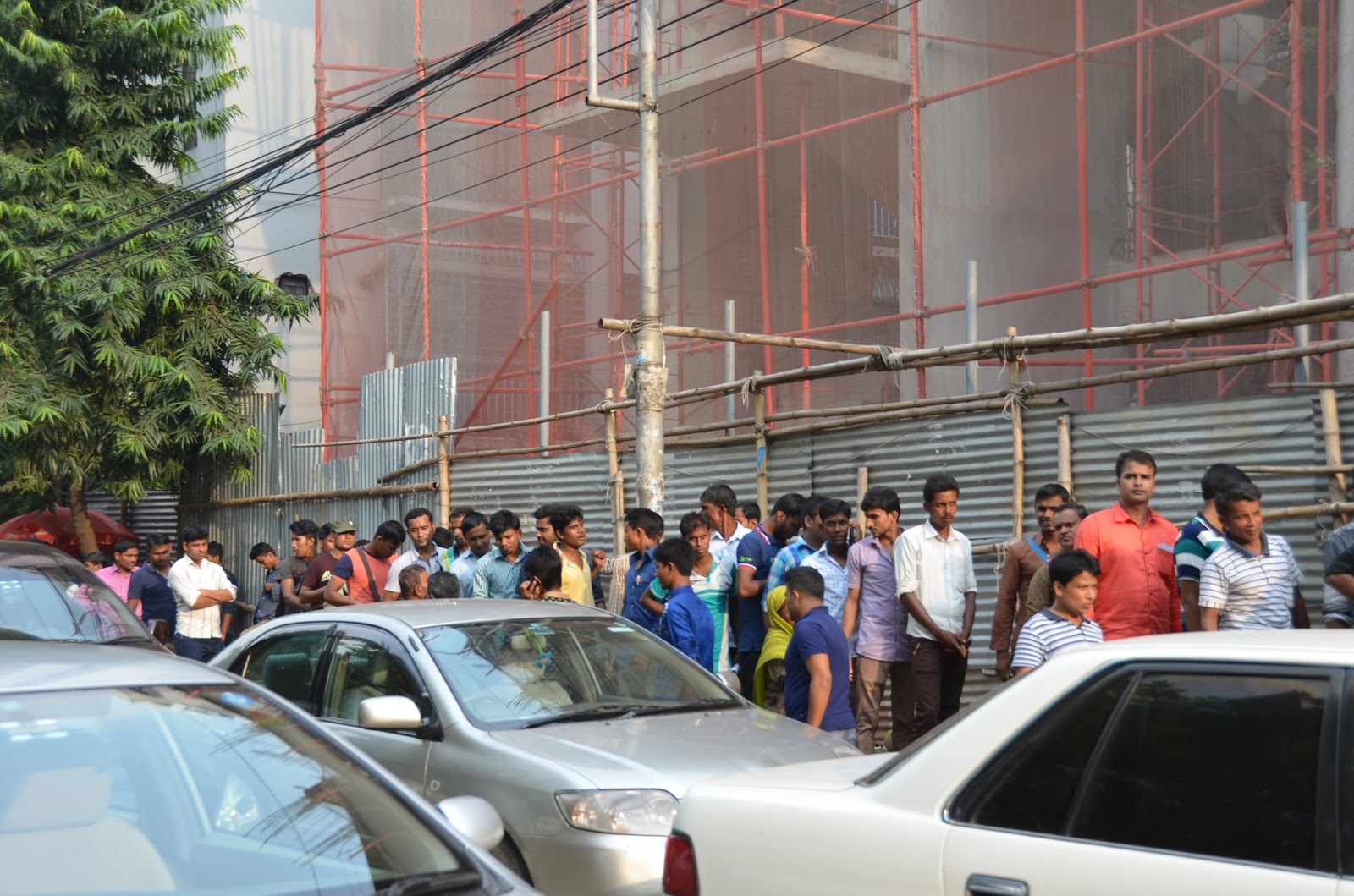
Tens of thounsand of (mostly) men have dreams of making a fortune in the Gulf states as foreign workers. They line up for hours for a medical attest in the heat or heavy rain or both.  


Often they have to borrow at least two years` salary for the paperwork and travel costs before they can earn any money.  Many never manage to pay their debts and end up working as badly treated slaves.
Every year half a million leave Bangladesh for a job in the neighboring countries. Manpower is number two export source after the garment industry.

Time for a little break from Dhaka, back in November.